


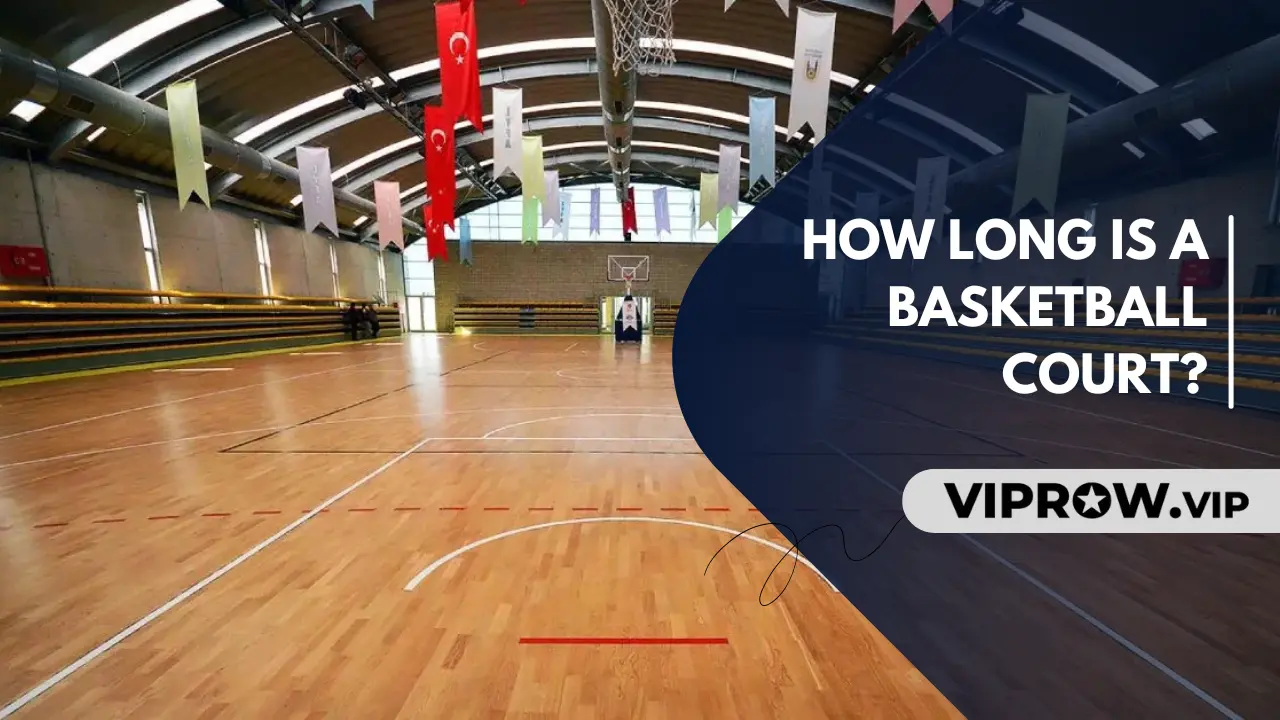
How long is a basketball court? A standard basketball court is 94 feet long by 50 feet wide for professional basketball leagues like the NBA and NCAA. However, basketball court dimensions vary depending on the level of play, with high school courts measuring 84 feet long by 50 feet wide, and junior high courts typically stretching 74 feet in length. Whether you’re a player, coach, or court designer, knowing the exact measurements is critical for proper gameplay, strategy development, and construction planning.
The precision of a basketball court isn’t just about drawing lines on pavement. Every measurement from the backboard placement to the three-point line distance directly impacts how the game is played. When Dr. James Naismith invented the sport of basketball in 1891, he could hardly have imagined the detailed specifications that would eventually govern court construction worldwide. Today, these measurements ensure fair play and consistent experiences whether you’re shooting hoops on your home court or watching professionals compete at the highest level.
How Long is a Basketball Court? (Official Dimensions by League)
| League | Court Length | Court Width | 3-Point Distance |
| NBA / WNBA | 94 Feet | 50 Feet | 23.75 Feet |
| NCAA (College) | 94 Feet | 50 Feet | 22.15 Feet |
| High School | 84 Feet | 50 Feet | 19.75 Feet |
| Junior High | 74 Feet | 42-50 Feet | Varies |
| FIBA (International) | 28 Meters | 15 Meters | 6.75 Meters |
Professional Standards (NBA & WNBA)
The National Basketball Association sets the gold standard for basketball court dimensions in North America. NBA courts measure exactly 94 feet long and 50 feet wide, creating a playing surface of 4,700 square feet. This court is 94 feet long by 50 feet wide specification has remained consistent for decades, allowing basketball players to develop muscle memory and coaches to design plays with confidence.
The WNBA follows identical measurements, ensuring that professional women’s basketball maintains the same spatial dynamics as the men’s game. Every NBA basketball court features precise marking that must meet league specifications, from the center of the court to the end of the court. The consistency across all NBA courts means players never need to adjust their game based on venue dimensions.
College Standards (NCAA)
The NCAA court mirrors professional dimensions precisely. College basketball courts measure the same 94 feet long and 50 feet wide as NBA facilities, though the three-point line distance differs significantly. This consistency in length and width helps prepare student athletes for potential professional careers while maintaining competitive integrity across hundreds of college programs.
The NCAA has maintained these full dimensions since standardizing court specifications, recognizing that the dimensions of a basketball court directly influence player development. The court used in NCAA tournaments follows identical specifications to regular season facilities, ensuring no team gains an unfair advantage due to unfamiliar dimensions.
International Standards (FIBA)
The International Basketball Federation (FIBA) uses metric measurements that create slightly different proportions. FIBA courts measure 28 meters long by 15 meters wide (approximately 92 feet by 49 feet when converted). While the difference seems minor, international basketball players must adjust their spacing and shooting ranges when transitioning between FIBA courts and NBA courts.
These dimensions for high school and professional play outside North America affect everything from fast break timing to defensive positioning. The width of the court particularly impacts lane spacing and help defense rotations, making the adjustment period crucial for players moving between international basketball and the NBA.
High School Basketball
Most high school courts are 84 feet long by 50 feet wide, exactly 10 feet shorter than professional specifications. This basketball court size reduction accommodates smaller gymnasiums while maintaining the same 50 feet wide dimension, preserving the side-to-side spacing that’s critical for proper offensive sets and defensive positioning.
The shorter length of the court affects transition play significantly. Teams playing on high school courts must adjust their fast break timing and full court press strategies compared to what they’d use on professional-length surfaces. Despite the reduced length, the basketball hoop remains at the standard height of 10 feet, and the free throw line stays 15 feet from the backboard.
Junior High Basketball
Junior high basketball courts typically measure 74 feet in length, scaled down further to suit younger athletes still developing their skills and conditioning. These courts are 84 feet long by 50 feet wide for high school, but junior high facilities reduce the court to approximately 74 feet, creating a more manageable playing surface for middle school athletes.
The reduced court size helps younger basketball players develop proper fundamentals without the exhausting demands of full-court play on NBA-sized surfaces. Court sizes vary at this level more than any other, with some facilities using full high school dimensions while others adopt the shorter specification.
Read more : How Long Is a Basketball Game? Average Length by League
Breaking Down the Basketball Court Dimensions
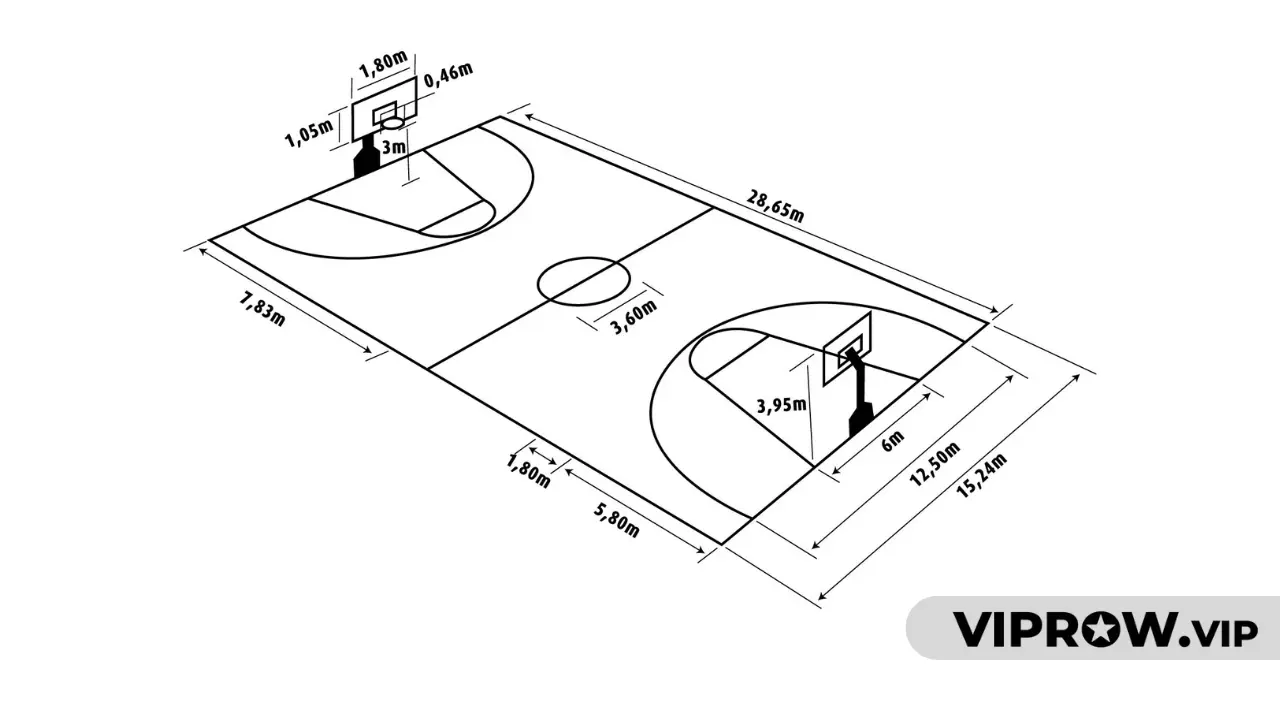
The Perimeter: Length vs Width Across All Levels
The perimeter boundaries define the legal playing area. While the 94 feet long by 50 feet wide NBA standard creates a rectangular court with specific proportions, the consistent 50 feet wide measurement across NBA, NCAA, and high school levels maintains lateral spacing. Only the court length changes between professional and high school play, preserving the width of the court at exactly 50 feet across nearly all regulation facilities.
Indoor basketball courts must include additional space beyond these boundaries for player safety. Most facilities add 6 feet of buffer space on all sides, increasing the total footprint significantly beyond the official dimensions.
The Key and Painted Area
The painted area, commonly called “the key,” measures 16 feet wide in the NBA and NCAA, extending from the baseline to the foul line. The FIBA key differs significantly at 4.9 meters (approximately 16.1 feet) wide. This zone plays a crucial role in defensive positioning and the three-second rule enforcement.
The free throw lane includes additional marking 4 feet from the baseline on each side, creating the blocks where players position for rebounds. These court markings must be precisely painted according to league specifications, with tolerances measured in fractions of an inch.
The Three-Point Line
Perhaps no basketball court dimension varies more between leagues than the three point arc. The NBA three-point line extends 23.75 feet from the center of the basket at the top of the key, while NCAA courts use 22 feet for men and 20.75 feet for women. High school three-point lines typically measure 19.75 feet, and FIBA uses 6.75 meters (approximately 22.15 feet).
This three-point line variation dramatically affects shooting strategy and floor spacing. Players transitioning between levels must recalibrate their range and shot selection based on the specific three point distance they’re facing.
The Restricted Area
The restricted area arc, introduced to reduce dangerous charging collisions, consists of a semicircle with a radius of 1.25 meters (4 feet) from the center of the basket. This no-charge zone prevents defenders from establishing position directly under the hoop, protecting both offensive and defensive basketball players from injury.
Half Court vs Full Court: What’s the Difference?

Half Court Utility
A half court setup provides an economical option for recreational play, practice scenarios, and backyard basketball court installations. Many basketball players spend more time playing 3-on-3 half court games than full court runs, making half court dimensions extremely practical for residential construction.
Half Court Dimensions
A regulation half court measures 47 feet long by 50 feet wide when using NBA proportions, or approximately 42 feet by 50 feet when based on high school dimensions. These measurements include the baseline, half of the center court line, and one basketball goal complete with backboard and hoop.
The beauty of half court construction lies in its versatility. Many court designers recommend slightly extending beyond the exact half court measurement to provide adequate space behind the baseline for shooting practice and layup approaches. Adding an extra 4 feet behind the basket creates a more functional practice environment.
Transitioning from Full Court
The strategic differences between half court and full court basketball are substantial. Half court play eliminates fast break opportunities and emphasizes halfcourt offensive sets, pick-and-roll execution, and positional defense. Players training exclusively on half court surfaces may struggle with full court conditioning and transition defense when moving to competitive play.
Youth and Junior High Basketball Requirements
Junior High Standards
Junior high basketball facilities balance developmental needs with facility constraints. The typical 74 feet length provides enough space for proper skill development while accommodating the reduced stamina of middle school athletes. Court markings remain proportionally similar to regulation courts, with adjusted three point distances appropriate for younger shooters.
Adapting the Game
The basketball court size at junior high levels directly supports athletic development. Younger players learn proper spacing, court awareness, and positional play without the overwhelming demands of professional-sized surfaces. The scaled-down dimensions of a basketball court allow coaches to teach fundamentals in an age-appropriate environment.
Rim Height vs. Court Length
Despite the reduced court dimensions, the basketball hoop stays always 10 feet high from elementary through professional levels. This consistency allows young players to develop proper shooting form and arc that will translate as they advance. The backboard dimensions also remain standard, typically measuring 6 feet wide and positioned 15 feet from the foul line.
Planning Your Own Court: Tips from a Court Designer

Space Requirements
Before construction begins, measure the total available area including buffer zones. A full-size NBA court requires approximately 106 feet by 62 feet when including recommended 6 feet clearance on all sides. For a backyard basketball court using half court dimensions, plan for at least 53 feet by 56 feet of total space.
Material Matters
Three primary surface options dominate residential construction:
- Concrete: Durable and cost-effective, but prone to cracking in freeze-thaw climates
- Asphalt: Softer surface that’s easier on joints, requires more frequent resurfacing
- Court tile: Modular interlocking system offering superior performance and customization
The Benefits of Court Tile
Professional court designers increasingly recommend modular court tile for residential basketball court installations. Court tile provides excellent drainage, reduces joint impact compared to concrete, and allows for creative customization with multiple color options for the key, free throw areas, and perimeter boundaries. The interlocking system means damaged sections can be replaced individually without resurfacing the entire court.
The investment in quality court tile pays dividends through reduced maintenance, better playing characteristics, and the ability to create unique court markings that reflect personal style. Many court tile manufacturers offer templates matching NBA and NCAA specifications.
Working with a Court Designer
Professional court designers bring expertise in layout optimization, drainage planning, and basketball equipment selection. They ensure proper basketball court dimensions while accounting for site-specific challenges like slopes, trees, or building setbacks. A quality designer can maximize your available space while maintaining proper proportions for enjoyable play.
Essential Basketball Court Marking and Lines
Sidelines and Baselines
The boundary court line marking defines legal playing area. Sidelines run the length of the court (94 feet for NBA, 84 feet for high school), while baselines span the 50 feet wide dimension. These lines must be precisely 2 inches wide according to most league specifications.
The Midcourt Line
The center of the court features the midcourt line, dividing the playing surface and establishing backcourt violation boundaries. The 10-second rule requires offensive teams to advance past this line within 10 seconds in the NBA and NCAA, making this court marking crucial for rule enforcement.
The Free Throw Line
Positioned 15 feet from the backboard across all levels of play, the free throw line remains one of basketball’s most consistent measurements. The foul line measures 12 feet wide, extending from both sides of the painted area. This free throw distance has remained unchanged since the early days of basketball, representing one of the sport’s most sacred traditions.
The Coaching Box
Official court markings include a designated coaching box extending 28 feet from the baseline along the sideline. This zone defines where coaches may stand during live play, though enforcement varies by level of play and officiating crew.
Conclusion
Whether you’re on a 94-foot NBA court or an 84-foot high school court, standard basketball court dimensions are essential for skill development. While court length varies by league, core constants like the 10-foot rim height and the 15-foot free-throw line ensure the game’s integrity remains the same.
For those building a custom full court or half court, consulting a professional court designer is key. Using quality basketball equipment and precise marking ensures your space is optimized for play. Measure your area today and take the first step toward installing your own standard basketball court.
FAQs
How long is a high school basketball court vs the NBA?
High school courts are 84 feet long, which is exactly 10 feet shorter than the 94-foot NBA standard. Both share a 50-foot width.
What is the smallest size for a functional half court?
While you can fit a hoop in a 30′ x 25′ area, a regulation half court is 47′ x 50′ (Pro) or 42′ x 50′ (High School).
How many square feet is a standard basketball court?
An NBA full court is 4,700 square feet. A high school basketball court is 4,200 square feet.+1
Can I use different court tile colors for the key and perimeter?
Yes. Using contrasting court tile colors for the key and three-point areas is a popular way to create a professional, custom look.
