



How Big Is a Basketball Court? A standard NBA basketball court measures 94 feet long by 50 feet wide, covering 4,700 square feet of playing surface. However, basketball court dimensions vary depending on the level of play, with high school courts typically measuring 84 feet long and international courts using metric measurements of 28 meters by 15 meters.
Basketball court dimensions matters whether you’re a player studying game strategy, a coach planning practice drills, a school administrator planning facility construction, or a homeowner considering a backyard basketball court. The dimensions of a basketball court directly impact player spacing, shooting angles, defensive strategies, and overall gameplay experience. This guide to basketball court dimensions breaks down exact measurements, key markings, and how court dimensions vary across different competitive levels.
Standard Basketball Court Dimensions Explained
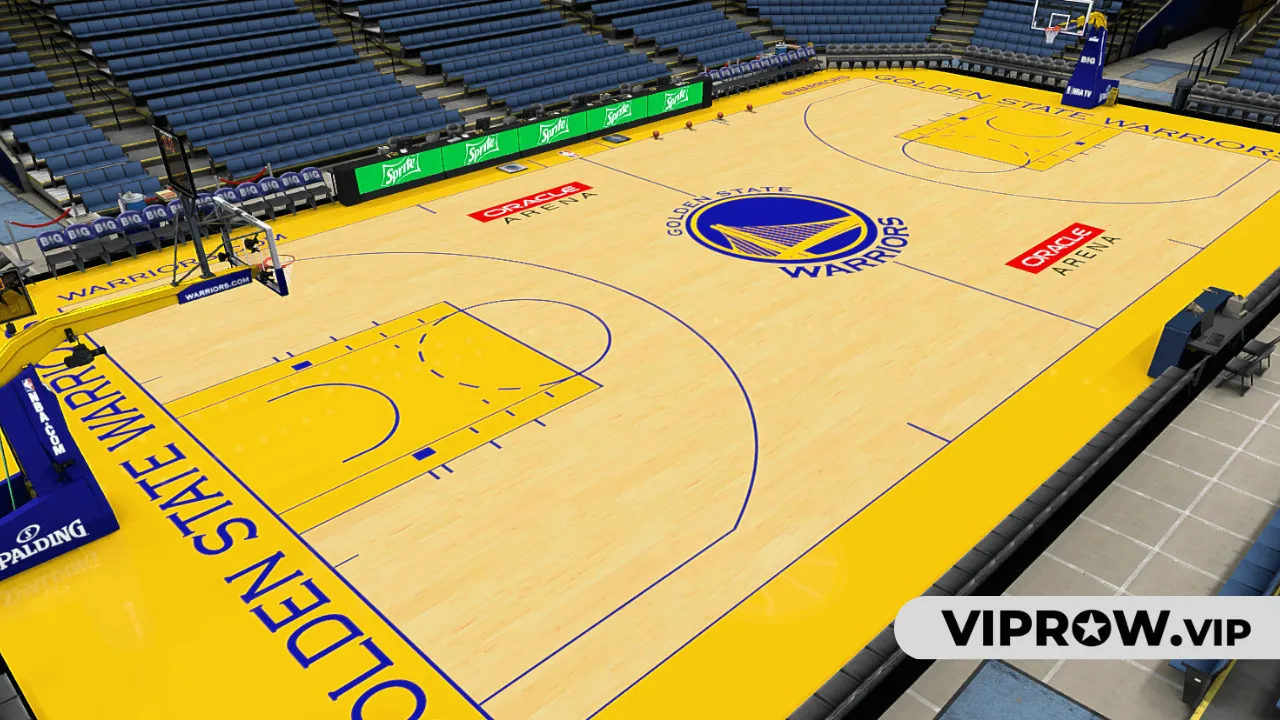
Official Dimensions of a Basketball Court
The National Basketball Association sets the standard for professional basketball in North America. NBA courts measure exactly 94 feet long and 50 feet feet wide, creating a rectangular playing surface of 4,700 square feet. This measurement has remained consistent since the league’s establishment, providing players with ample space for fast-paced gameplay and strategic positioning.
College basketball follows the same dimensions, with NCAA court measurements matching NBA standards at 94 feet by 50 feet wide. The NBA and NCAA share identical court size specifications, though some marking variations exist in areas like the three-point line distance and restricted area placement.
International basketball operates under different standards. The International Basketball Federation (FIBA) uses metric measurements, with courts measuring 28 meters long by 15 meters wide (approximately 91.9 feet by 49.2 feet). While slightly smaller than NBA courts, FIBA dimensions still provide sufficient space for competitive play at Olympic and international championship levels.
Read more : Does Playing Basketball Make You Taller? Exploring the Link Between Basketball and Height Growth
| League Type | Length | Width | Total Area |
|---|---|---|---|
| NBA/NCAA | 94 feet | 50 feet | 4,700 sq ft |
| High School | 84 feet | 50 feet | 4,200 sq ft |
| FIBA | 28m (91.9 ft) | 15m (49.2 ft) | 4,520 sq ft |
| Junior High | 74 feet | 42 feet | 3,108 sq ft |
Why Basketball Court Dimensions Matter
Court size directly influences gameplay strategy and player performance. A full-size court allows teams to implement fast-break offenses, full-court presses, and transition defense. The distance from sideline to sideline determines spacing for perimeter shooters and driving lanes for guards.
The length of the court affects conditioning requirements. Players covering 94 feet repeatedly throughout a game develop different stamina compared to those playing on shorter courts. Coaches design practice drills specifically around standard dimension specifications to prepare athletes for competitive scenarios.
Basketball Court Dimensions by Level of Play
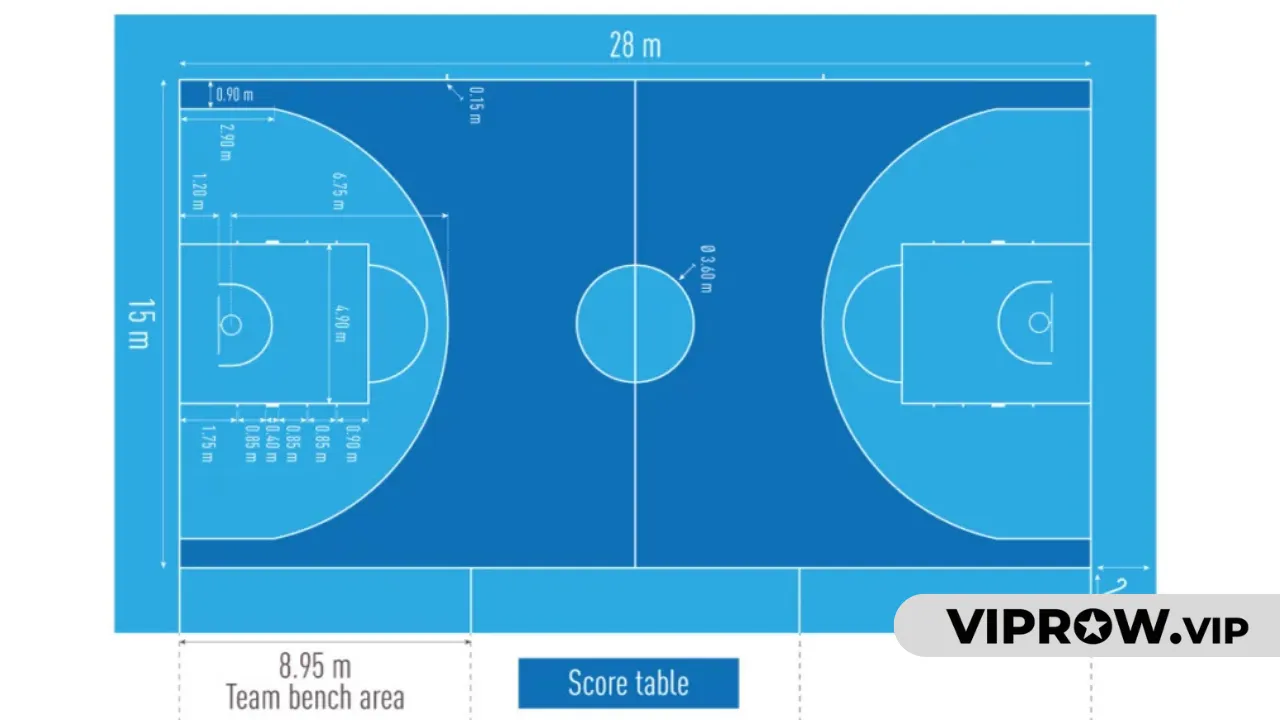
NBA Basketball Court Dimensions
NBA courts represent the gold standard in professional basketball. The court is 94 feet in length, with the basketball hoop positioned 10 feet above the playing surface at each end of the court. The backboard sits 4 feet inside the baseline, with the center of the basket located exactly at this regulation height.
Key NBA measurements include:
- Three-point line: 22 feet at the corners, extending to 23 feet 9 inches at the arc
- Free throw line: 15 feet from the backboard
- Free throw lane: 16 feet wide (also called the paint or key)
- Center circle: 12 feet wide diameter
High School and Junior High Court Dimensions
High school basketball court measurements differ from professional standards. Most high school courts measure 84 feet long by 50 feet wide, providing 10 fewer feet in length compared to NBA specifications. This basketball court size reduction accommodates smaller gymnasiums while maintaining proportional gameplay.
The high school basketball three-point line sits at 19 feet 9 inches from the basket, closer than NBA and NCAA distances. The free throw lane measures 12 feet wide, narrower than the 16 feet wide paint area found in NBA and NCAA facilities.
Junior high basketball court dimensions scale down further for younger athletes. A typical junior high court measures 74 feet by 42 feet, though some facilities use high school basketball dimensions. These modifications help developing players build fundamental skills without the physical demands of covering a full court.
FIBA and International Standards
FIBA courts used in Olympic competition and international tournaments measure 28 meters long by 15 meters wide. The free throw line sits 4.6 meters from the backboard, while the three-point line extends to 6.75 meters (approximately 22.15 feet) from the center of the basket. The paint area forms a trapezoid shape in FIBA play, contrasting with the rectangular key used in NBA competitions.
The WNBA follows NBA court dimensions for their professional women’s league, using the same 94 feet long by 50 feet measurements. This standardization allows WNBA teams to play in NBA arenas and share facilities seamlessly.
Full Court vs Half Court Dimensions
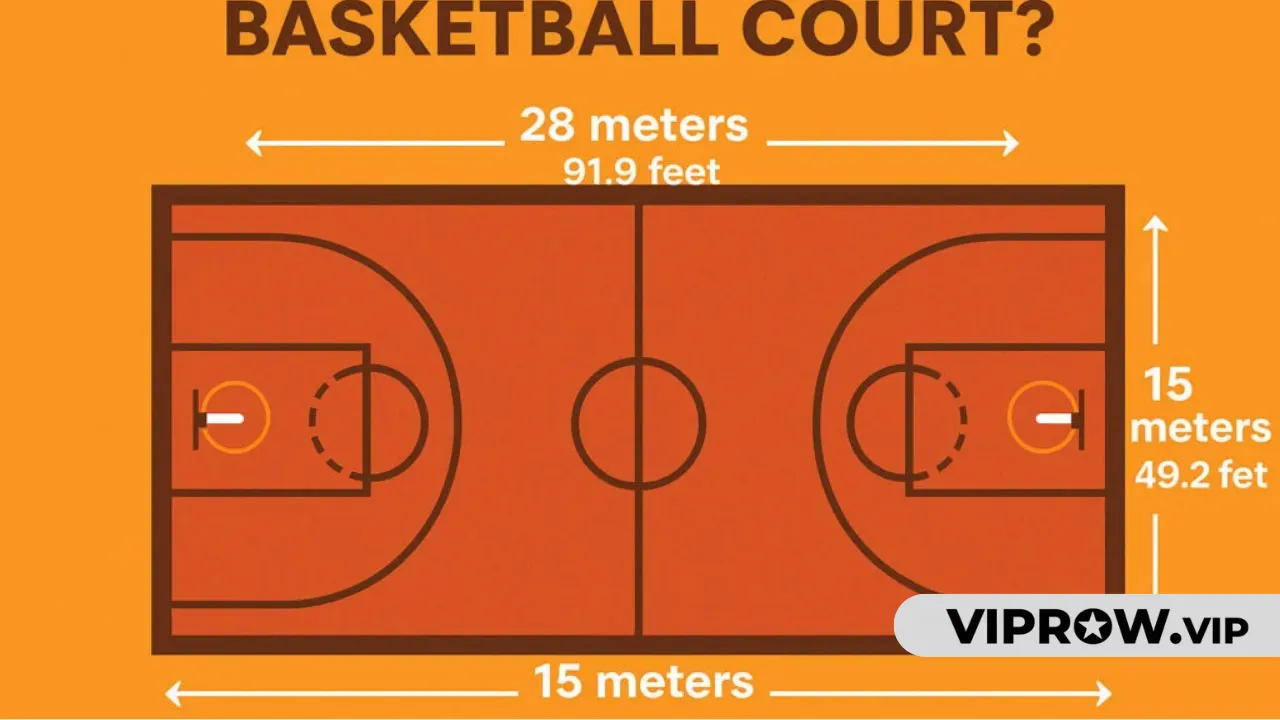
Understanding Full Court Basketball
A full court basketball setup includes both baskets with complete court markings from baseline to baseline. Full court games require teams to defend one basket while attacking the other, utilizing the entire 94-foot length (or applicable dimension for the specific type of basketball court). This format appears in all organized competitive games from junior high through professional levels.
Half Court Play and Dimensions
A basketball half court uses exactly one-half of the standard playing surface. For NBA standards, half court dimensions measure 47 feet by 50 feet wide. This setup includes one basketball hoop, the free throw circle, the paint area, and one three-point line.
Half court basketball serves multiple purposes:
- Practice sessions focusing on offensive sets
- Recreational games with limited space
- Youth development programs
- Backyard basketball court installations
- Home basketball court construction projects
The center of the court serves as the boundary line in half court play. Players must clear the ball beyond this line after defensive rebounds before attempting to score.
Essential Basketball Court Markings and Dimensions
Key Court Markings
Standard court markings include several critical lines and areas that run the length and width of the playing surface:
Baselines and Sidelines: The boundary lines that define the playing area. Baselines run perpendicular at each end of the court, while sideline markers run the length of the playing surface parallel to each other.
Three-Point Line: The arc determining three-point shot territory. Distance varies by league, with NBA three-point line measurements at 22 feet in corners and 23 feet 9 inches at the top of the arc. High school basketball places this line at 19 feet 9 inches.
Free Throw Lane: Also called the paint or key, this throw lane extends from the baseline to the free throw line. The NCAA and NBA use a 16 feet wide lane, while high school basketball employs a 12ft wide for college comparison purposes shows the variation.
Restricted Area: A 4 feet arc under the basket where defensive players cannot draw charging fouls. This restricted area appears in NBA and FIBA competition but follows different radius specifications.
Backboard and Basketball Goal Specifications
The backboard measures 6 feet wide by 3.5 feet tall in regulation play. The basketball goal rim sits exactly 10 feet above the playing surface—a height that’s always 10 feet regardless of league level from junior high basketball through NBA play.
The backboard dimensions remain consistent across competitive levels, though recreational outdoor basketball courts and home basketball court installations sometimes use smaller boards. The front of the backboard should sit 4 feet from the baseline, positioning the basketball hoop at the optimal shooting distance.
Building Your Own Basketball Court
Backyard and Home Court Considerations
Planning a backyard court or home basketball court requires understanding both standard dimensions and spatial requirements. A regulation half court needs approximately 47 feet by 50 feet of space, but additional clearance beyond the playing surface improves safety and gameplay quality.
Backyard basketball court options include:
- Full half court installation (47′ × 50′)
- Compact court (30′ × 30′ minimum)
- Driveway conversion with single hoop
- Custom dimensions based on available space
The type of basketball court surface matters significantly. Concrete provides durability for outdoor basketball courts, while asphalt offers slight cushioning. Professional-grade sports surfacing adds cost but improves performance and reduces injury risk.
Space and Budget Planning
Minimum recommended clearance adds 3-5 feet beyond playing dimensions on all sides. This buffer zone allows players to chase loose balls safely without collision risks. The side of the court clearance proves especially important near property boundaries or structures.
Construction costs vary based on basketball court size, surface selection, and marking complexity. A basic concrete court used for recreational play costs less than professionally surfaced indoor basketball courts. The court and is used for different purposes factor into material selection and dimension choices.
Key Measurements Quick Reference
- NBA/NCAA: 94 feet long by 50 feet wide (same size as NBA)
- High School: 84 feet long and 50 feet feet wide
- FIBA: 28m × 15m with radius of 1.25 meters for center circle
- Free Throw Distance: 15 feet from backboard
- Rim Height: Always 10 feet from playing surface
- Lane Width: 16 feet wide (NBA) or 12 feet wide (high school)
Conclusion
Basketball court dimensions help players, coaches, and planners create proper spaces for practice and competition. While sizes vary by league and age group, all courts share key markings and features that define the game. Official dimensions ensure fair, standardized play, while recreational courts allow more flexibility based on space and budget.
FAQs
How big is a full basketball court?
A full basketball court is typically 94 ft × 50 ft (NBA) or 84 ft × 50 ft (high school), with slight variations for FIBA and junior high courts.
What are the dimensions of a basketball half court?
A basketball half court is half the length of a full court, usually 47 ft × 50 ft (NBA) or adjusted for high school and junior high levels.
How big is a high school basketball court?
High school basketball courts are generally 84 ft × 50 ft, slightly smaller than professional courts, with specific markings for three-point lines and free throws.
What is the size of a junior high basketball court?
Junior high basketball courts are smaller than high school courts, often around 74–84 ft in length, to accommodate younger players and safety considerations.
